


I recommend Mullvad, and it is the VPN I trust most for privacy. You get a generated account number instead of an email address, you pay a flat €5 a month, and the company has a court-tested record of holding nothing about its customers. It is the wrong VPN if you want Netflix, a big server list or more than five devices.
The proof is public. Swedish police visited the Gothenburg office with a search warrant in April 2023 and left without taking anything, because there was no customer data to take. Mullvad also publishes its audits, and the latest one, by X41 D-Sec on the account and payment systems, appeared in January 2026.
Most VPN rankings are sorted by affiliate payout, and Mullvad does not pay commissions. That is part of why it is missing from so many lists. In my best VPN roundup it sits in the "recommended" group, and I wrote that it is the provider I trust most for privacy.
This review covers the service as of March 2026, after Mullvad dropped OpenVPN in January. Prices and server numbers come from Mullvad's own pages, checked in March 2026. If something here no longer matches what you see, tell me in the comments.
Quick verdict
- Good for: people who care about anonymity first, want to sign up and pay without handing over personal details, and are happy with a small, plain app.
- Skip it if: streaming is the main reason you want a VPN, you need more than 5 devices on one account, or you want port forwarding, dedicated IPs or a favourites list.
- Price: €5 a month, any term, with no renewal increase and no multi-year discount. Paying with crypto gets 10% off.
- Refund: 14 days, but not for cash payments.
- Biggest downside: about 570 servers in 50 countries, and no streaming support worth planning around.
1. Speed: consistent, not the fastest
My own speed tests are in the VPN roundup. I tested from a 1 Gbps fiber connection in the EU, using WireGuard or each provider's equivalent, to servers in Europe and the US. Each provider ran across multiple sessions over two weeks.
| Mullvad result (my roundup) | Figure |
|---|---|
| Average download retention (local servers, EU) | 75-85% |
| Average download retention (international, EU to US) | 60-75% |
| Peak speed on a nearby server | 600+ Mbps |
| Latency impact | Low |
For comparison, NordVPN retained 85-96% and peaked at 1200+ Mbps in the same roundup, so Mullvad is clearly behind the fastest provider. What I wrote after two weeks of daily use still holds: Mullvad's speed was consistent and predictable. It is not the fastest, but I saw no random slowdowns or server congestion.
If your connection is under 100 Mbps, which is common across much of Europe, you will not notice the gap. It shows up on 300+ Mbps lines or on connections to another continent.
An independent test points the same way. Gizmodo's review measured about 342 Mbps down without a VPN. It got 322 Mbps on a UK server (5.8% loss), 217 Mbps on a US server (36.6% loss) and 149 Mbps on a Japan server (56.4% loss). Distance costs speed, as with every VPN. Gizmodo also found that multihop combined with Shadowsocks obfuscation cost about 30% of speed.
2. What Mullvad logs, and how it proved it
Mullvad's no-logging policy is more detailed than most. It stores your account number, its expiry date and, for WireGuard, a public key and tunnel address. It does not store traffic, DNS requests, IP addresses, connection times or per-user bandwidth. The limit on simultaneous connections is handled in temporary memory only.
Payments leave a small record: account number, amount, currency and timestamp. Mullvad deletes some of the detail after 20 days, such as the time of day on card and PayPal payments. Cash envelopes are shredded once the time is added to the account. Card and PayPal processors keep their own records, so cash or Monero is the cleaner route if payment privacy matters to you.
Mullvad said at least six officers from the National Operations Department arrived with a warrant to seize computers holding customer data. After the company explained how the service works and the officers spoke to the prosecutor, they left empty-handed. Mullvad said it was the first search warrant at its offices in more than 14 years of running the VPN, and the full account is on its blog.
One raid is a single event, so the audits carry more weight.
3. Audits: five on the list, all linked
Mullvad's external audits page lists reviews of its apps, infrastructure and account systems. These are the ones in my fact record for Mullvad:
| Year | Auditor | Scope |
|---|---|---|
| 2026 | X41 D-Sec | Account and payment services |
| 2025 | Assured | Web app |
| 2025 | NCC Group | Android app |
| 2024 | Cure53 | Infrastructure (fourth infrastructure audit) |
| 2023 | Radically Open Security | Infrastructure |
The Cure53 audit, run in June 2024, found a low-severity local privilege escalation and a medium-severity bug that let a user hide from Mullvad's own unauthorized-login check. Mullvad fixed both. Cure53 reported no issues affecting VPN traffic anonymity or integrity.
The X41 D-Sec audit found five security-relevant findings, three medium and two low. The most notable was a voucher race condition that could let one voucher be applied to several accounts. Mullvad says it affects billing only, and that none of the findings expose user data. Four findings were redacted from the public report because they describe possible availability issues, so you are trusting Mullvad's summary on those.
One caveat. These audits mostly cover apps, infrastructure and account systems. I could not find a recent audit that is specifically a no-logs verification in the style some competitors publish. Mullvad's argument is that it collects almost nothing, and the 2023 raid supports that, but it is a different kind of proof. Also note that the comparison table in my roundup listed only one audit (Assured AB), which is out of date next to the list above.
4. Ownership and jurisdiction
Mullvad VPN AB runs the service from Gothenburg, Sweden, and has done so since 2009. Per Gizmodo, the founders Fredrik Strömberg and Daniel Berntsson still own the company. There is no parent group, no private equity owner and no sister products to cross-sell. I think that is a real advantage next to the Nord Security and Kape ownership stories I describe in my roundup.
Sweden is in the Fourteen Eyes surveillance alliance. In my roundup I put it this way: Mullvad and Surfshark sit in the Fourteen Eyes but have strong domestic privacy laws. Jurisdiction decides what legal tools a government can use against a VPN company, and Mullvad's answer is to hold nothing worth demanding. If your threat model requires a country outside every alliance, Proton VPN (Switzerland) is the closer fit.
5. Features and protocols
Mullvad's feature list is short and deliberate:
- WireGuard only. Mullvad removed OpenVPN on 15 January 2026 from both servers and apps. If you use a router or a third-party client with OpenVPN, it stopped working that day. My older roundup table still lists OpenVPN, so treat that as out of date.
- Quantum-resistant tunnels. Optional on all supported platforms, in case future quantum computers can break today's key exchange.
- Multihop. Sends traffic through two or more servers in separate jurisdictions, at a cost in speed.
- DAITA. Defense Against AI-guided Traffic Analysis pads packets and adds fake ones so an observer cannot guess which sites you visit from traffic patterns.
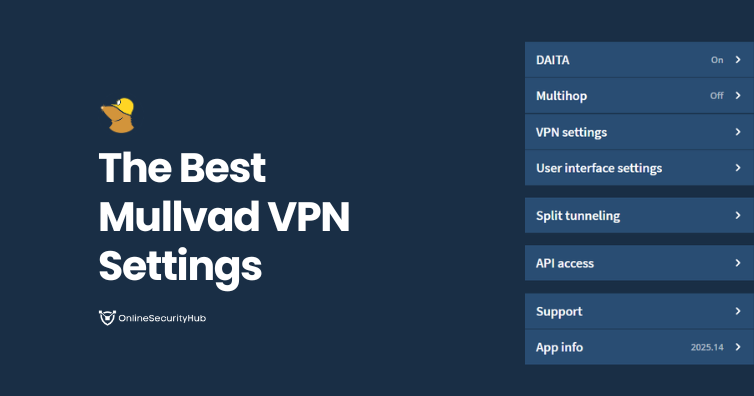
- Always-on kill switch. According to my settings guide, it cannot be turned off. Lockdown Mode goes further and blocks internet access even after you press Disconnect.
- DNS content blockers. Ads, trackers and malware, with optional gambling, adult and social media blocking.
- No port forwarding. Adding new ports was disabled on 29 May 2023. My roundup table said yes here, which is wrong today. If you torrent and need open ports, Mullvad will not work for you.
I explain every one of these in my Mullvad VPN settings guide, including which ones I turn on (quantum-resistant tunnel, Lockdown Mode, DAITA, DNS blockers for ads, trackers and malware) and which ones I leave off (Multihop, split tunneling, local network sharing).
6. Apps and devices
Apps exist for Windows, macOS, Linux, Android and iOS, and the client apps are public on GitHub under GPLv3. The interface is minimal on purpose. There is no favourites list and no recent connections panel. You pick a location and connect.
One account covers up to 5 devices, and Mullvad does not sell extra slots. Gizmodo notes that NordVPN and Proton VPN each allow 10. My roundup table said unlimited connections, so please go by Mullvad's page. There is no Fire TV app either, per Gizmodo. For a family with many devices, Surfshark is the better fit.
Android has one catch that is not Mullvad's fault. Android itself can let DNS lookups slip outside the tunnel for a moment, and Mullvad has said it cannot fully prevent this. I wrote up the Private DNS check and the details in the settings guide.
7. Server network: smaller than the roundup said
In my roundup I wrote about 700 servers in 49 countries. Mullvad's own server list now shows 570 servers in 50 countries and 91 cities, with 31 offline when I checked. Gizmodo says about 130 of these belong to Mullvad itself and every server is RAM-only, while the rest are rented from 14 providers. So the network is smaller than I listed, and mostly rented.
There are no virtual locations, no dedicated IPs and no specialty servers. Every server is a plain general-purpose one. P2P is allowed everywhere. Per my roundup, speed stays consistent, which is the upside of not stretching a network thin.
8. Streaming: do not buy it for this
My view in the roundup is blunt: Mullvad will not unblock Netflix, and I rated its streaming success at about 10%. Gizmodo's test was a little kinder. Netflix US, BBC iPlayer and 9Now worked, but Hulu, Prime Video US and HBO Max US were blocked, and some streams buffered before playing. Streaming sites update their blocks constantly and Mullvad has no streaming servers to adjust, so I would not count on it. NordVPN unblocked every service Gizmodo tried.
9. Price: the one VPN without a renewal trap
The price is €5 per month (about $5.50), the same whether you pay for 1 month, 1 year or 10 years. The price has been flat since 2009, according to my settings guide. There are no sales or holiday promotions. Crypto payments get 10% off, per the same page.
| Item | Mullvad |
|---|---|
| Monthly price | €5, any term |
| Renewal price | Same €5 |
| Free plan or trial | None |
| Refund | 14 days, not for cash |
| Devices | 5 |
| Payment | Cash by post, Bitcoin, Bitcoin Cash, Monero, card, PayPal, Swish, bank wire and local methods |
Accounts do not renew automatically, per Gizmodo. You top up when you want. My roundup's comparison table said the default was auto-renewal, so check the account page before you pay by card.
The 14-day refund is shorter than the 30 days at most competitors, and the pricing page excludes cash payments (Mullvad's VPN page also mentions crypto). Test it hard in the first two weeks. Over three years it still costs less than most "cheap" two-year deals once those renew, which I explain in my choosing tips.
Prices change often, so check the final amount on the checkout page.
10. Support
There is no live chat or phone line. Support is by email and through the help pages. In my roundup I rated the response quality as good and the knowledge base as good but basic.
11. Incidents
I know of no breach or logging scandal. The only notable event is the 2023 police visit covered above, which ended in Mullvad's favour. The one thing I would flag is the January 2026 OpenVPN shutdown. It was announced well in advance and Mullvad said fewer than 7% of users were on it, but TechRadar reported the disruption hit routers, third-party clients and custom setups.
12. What I would use instead
| If you want | Look at |
|---|---|
| Privacy plus streaming and easy daily use | Proton VPN (Switzerland, audited, Secure Core) |
| A small, privacy-first rival with Multihop built in | IVPN (Gibraltar, more expensive) |
| Streaming and speed | NordVPN, but check the renewal price |
| Cheap with many devices | Surfshark |
The full ranking is in my best VPN guide, and you can browse more in VPN services.
Who Mullvad is for
Pick Mullvad if you want a VPN that cannot tell the police who you are because it never knew. Skip it if you need Netflix, a large network, port forwarding or six or more devices. A VPN only hides your traffic from your ISP and changes your IP address. If you log into Google while connected, Google still knows who you are.
My verdict: recommended.
FAQ
Does Mullvad keep logs?
Mullvad says it does not store traffic, DNS requests, IP addresses or connection times. It keeps your account number, expiry date and payment records, as described in its no-logging policy.
Can I use Mullvad without an email address?
Yes. Mullvad generates the account number for you, so signing up needs no email, name or password, as covered in the product page and my settings guide.
Does Mullvad still support OpenVPN?
No. OpenVPN support and servers were removed on 15 January 2026. Mullvad now runs on WireGuard only.
Does Mullvad work with Netflix?
I would not count on it. In my roundup it does not unblock Netflix, and Gizmodo's test was mixed: Netflix US and BBC iPlayer worked, Hulu, Prime Video US and HBO Max US did not.
How many devices can I use?
Five per account, according to the pricing page. There is no way to buy more.
Is Sweden a bad country for a VPN?
Sweden is in the Fourteen Eyes alliance, but I rate its domestic privacy laws as strong, and Mullvad held up during the 2023 police visit. If you want a country outside every alliance, consider Proton VPN.
Comments 0
No comments yet. Questions, corrections and your own experience are all welcome.