


I have run Bitdefender Total Security on my own test machines for the past five years, alongside Keeper, NordVPN, and Mullvad in my regular stack. Every time a new AV-TEST or AV-Comparatives round lands, I check whether the marketing still matches the lab data. With Bitdefender, usually the lab data holds up completely each and every year. My confidence drops on the checkout page though.
- How Did Bitdefender Score in the Latest Independent Lab Tests?
- How Does Bitdefender's Detection Engine Actually Work?
- What Is Bitdefender Actually Like to Use?
- How Much Does Bitdefender Actually Cost in 2026?
- Which Bitdefender Plan Should You Actually Buy?
- What Do Real Bitdefender Users Say?
- Who Owns Bitdefender, and Does It Matter for Your Data?
- Bitdefender vs Windows Defender: Do You Actually Need to Pay?
- What Works Well
- What Needs Work
- Who Should Buy Bitdefender, and Who Should Not?
- Is Bitdefender Worth Buying in 2026?
- Bitdefender Review FAQ
How Did Bitdefender Score in the Latest Independent Lab Tests?
I do not trust a vendor’s own claims about detection rates. I trust the labs that test the product without Bitdefender’s marketing team in the room.
AV-TEST’s May-June 2026 evaluation put Bitdefender Total Security 27.0 through its paces on Windows 11 Professional, one of 16 home-user security products tested that round. Bitdefender scored a perfect 6.0 out of 6.0 in each of the three categories AV-TEST measures. That is 18 out of 18 points and AV-TEST’s Top Product award. In the June round, Bitdefender blocked 100% of the 224 real-world zero-day samples used and 100% of the 11,772-sample reference set for widespread malware. The industry average on the zero-day test that same month was 99.9%, so Bitdefender was not alone at the top, but it was there.
Here is the scorecard directly from the report:
| AV-TEST category (May-June 2026) | Bitdefender score |
| Protection | 6.0 / 6.0 |
| Performance | 6.0 / 6.0 |
| Usability | 6.0 / 6.0 |
| Total | 18 / 18, Top Product |
AV-Comparatives ran a separate Real-World Protection Test from February to May 2026, exposing 20 consumer security products to 400 live malicious URLs. Bitdefender blocked 398 of 400, a 99.5% protection rate, and earned the highest award tier, Advanced+. Only Kaspersky scored higher, at 99.8% with 399 blocked, and that difference is mostly academic for many readers: Kaspersky antivirus products cannot legally be sold in the United States since the Department of Commerce’s ban took effect in September 2024, though the product remains available in the EU and UK. Norton, Avast, and AVG each blocked 397, for 99.3%.
Bitdefender’s false positive count in that same test was 5, level with Avast, AVG, Norton, and TotalAV, and below the field’s average of roughly 8.
Two labs, two different methods, and the same conclusion: Bitdefender’s detection is not a marketing figure. It holds up under scrutiny from testers who have no reason to go easy on it.
How Does Bitdefender's Detection Engine Actually Work?
A modern antivirus does not just check a file against a signature list anymore. Bitdefender runs threats through several layers before deciding whether to allow, warn, or block.
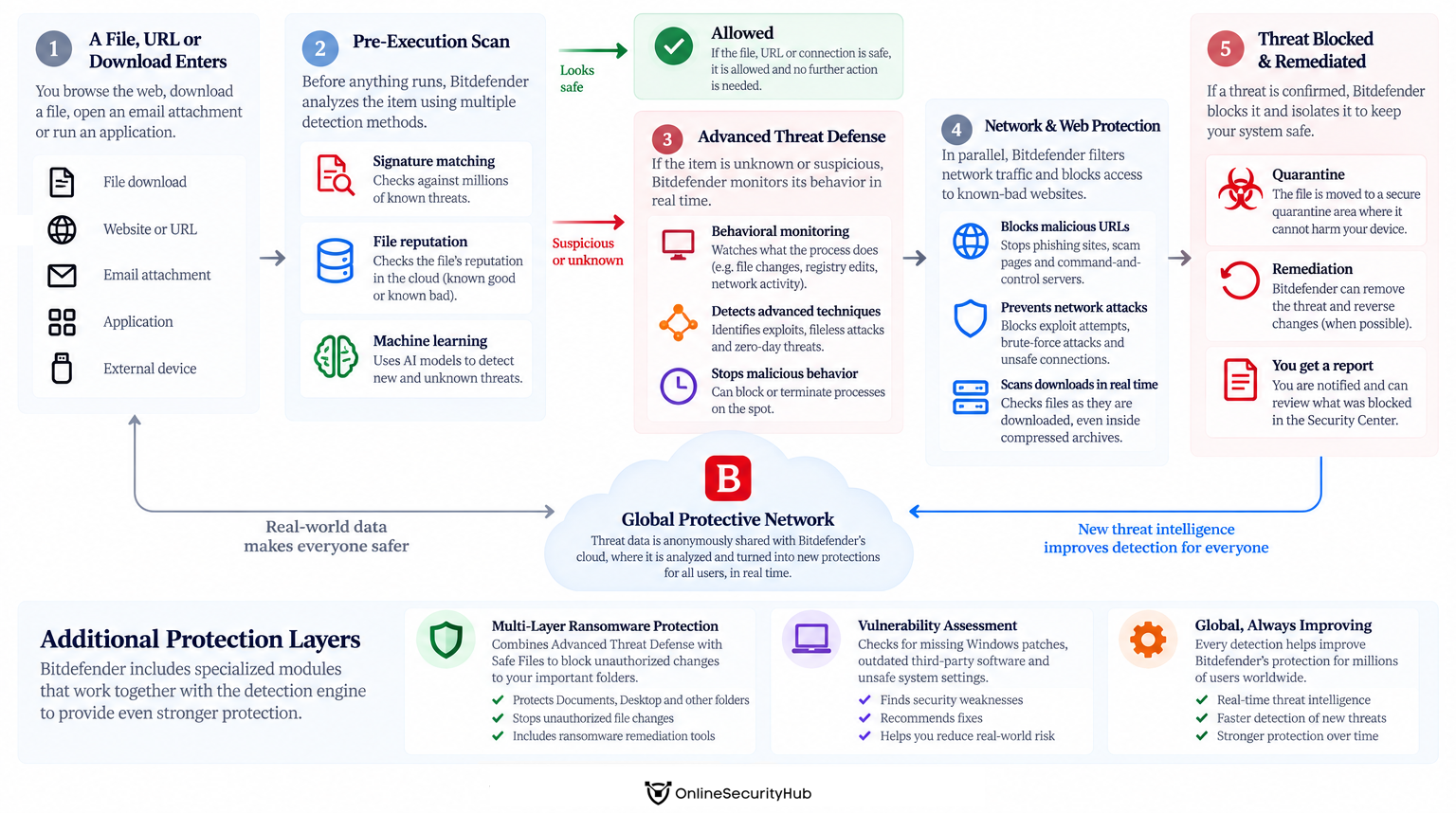
The first layer is pre-execution, signature matching, file reputation checks, and machine learning models look at a file or script before it runs.
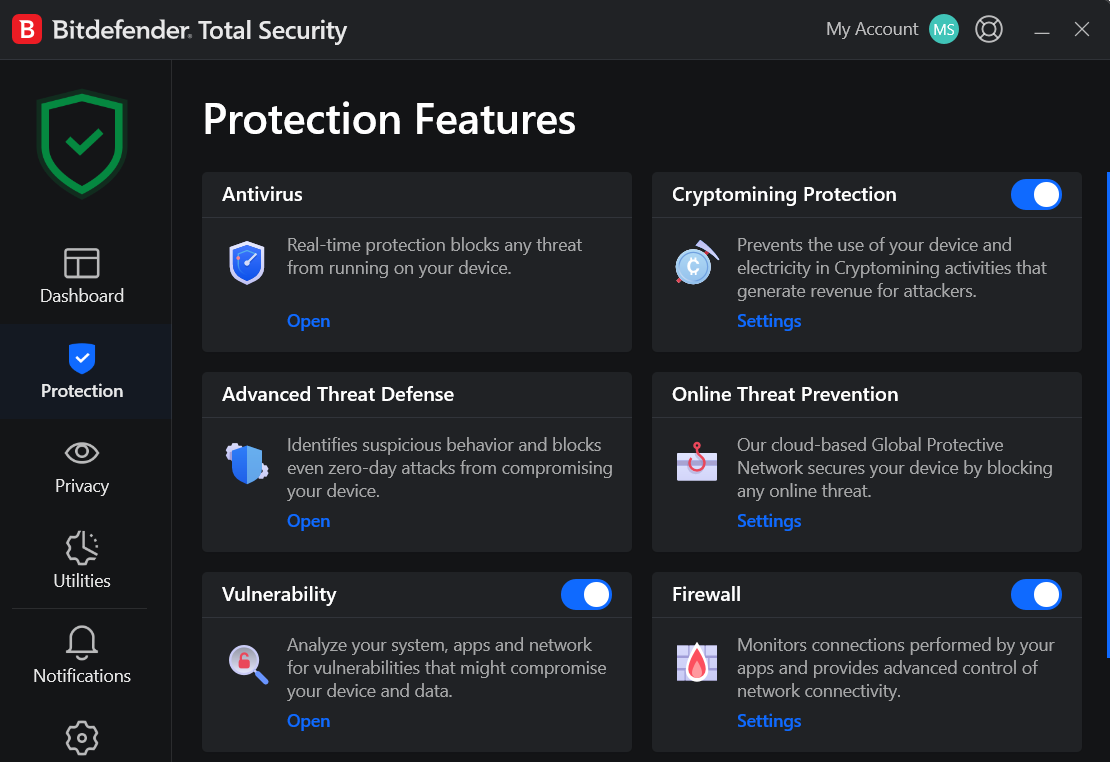
If something is unknown or behaves oddly Advanced Threat Defense takes over. It continuously monitors running apps and processes, correlates patterns of suspicious behavior instead of judging a file only by what it looks like on disk, and can block or terminate a process the moment it turns malicious. A built-in Exploit Detection component, enabled by default, watches for attempts to abuse bugs in installed software, which is how most zero-day attacks actually get in.
Two more layers work before a threat even reaches that stage. Network Threat Prevention monitors traffic at the network level and is built to catch brute-force attempts, botnet activity, and attempts to exploit system vulnerabilities before they reach the device. Online Threat Prevention covers the browser side: it automatically blocks known-malicious websites, phishing pages, and unsafe downloads as you browse.
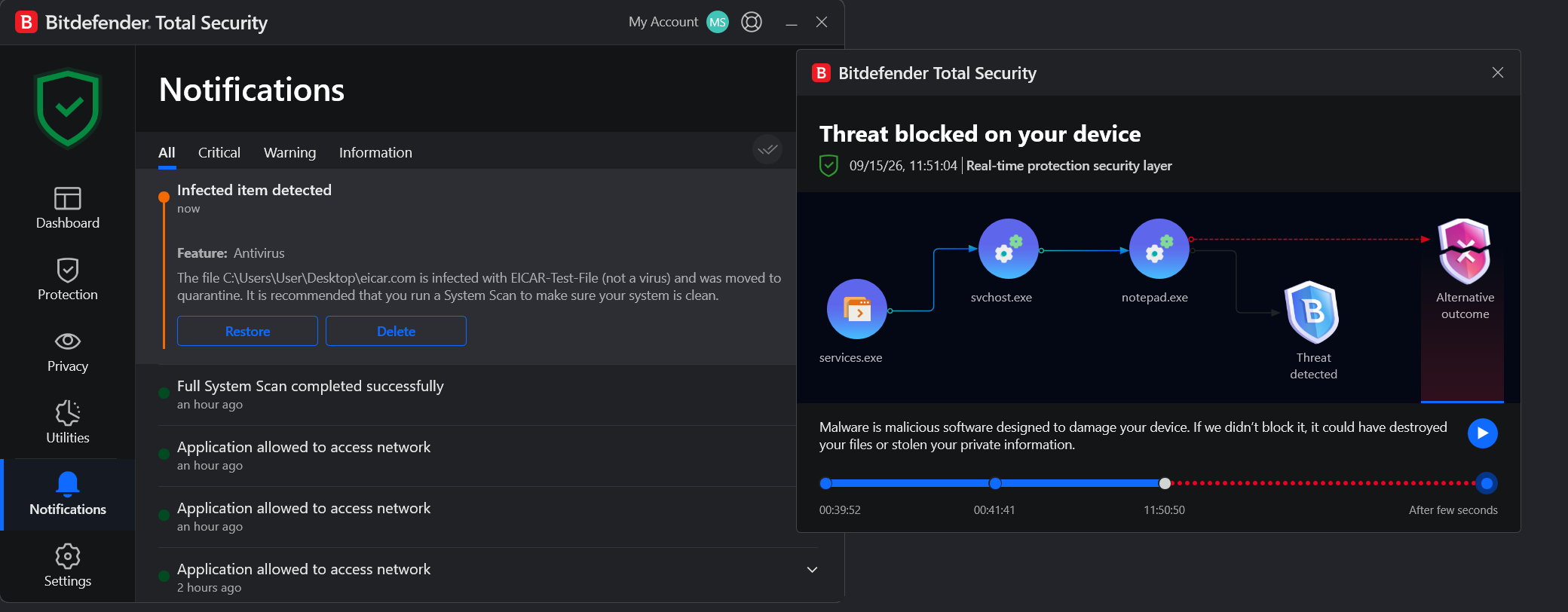
Bitdefender calls the cloud engine behind most of this the Global Protective Network. Most of the heavy scanning happens there instead of on your device, which is part of why the performance numbers below stay low. When a threat is confirmed at any of these stages, Bitdefender moves it to a quarantine folder and logs the detection, so you can check what was caught and when in the app’s notification history instead of getting a bare “threat blocked” popup with no detail.
On top of that sits Multi-Layer Ransomware Protection, which pairs Advanced Threat Defense with Safe Files, a feature that blocks unauthorized applications from touching folders you mark as protected. I keep this pointed at Documents, Desktop, and client project folders. There is also Vulnerability Assessment, a separate function from malware scanning entirely. It checks for missing Windows patches, outdated third-party software, and unsafe system settings, which does more for real risk reduction most weeks than another malware scan.
What Is Bitdefender Actually Like to Use?
Installation is fast. You download the installer, sign into a Bitdefender Central account, and protection starts immediately, before you configure anything. For a consumer product, that is the right default. Most people never open the advanced settings menu.
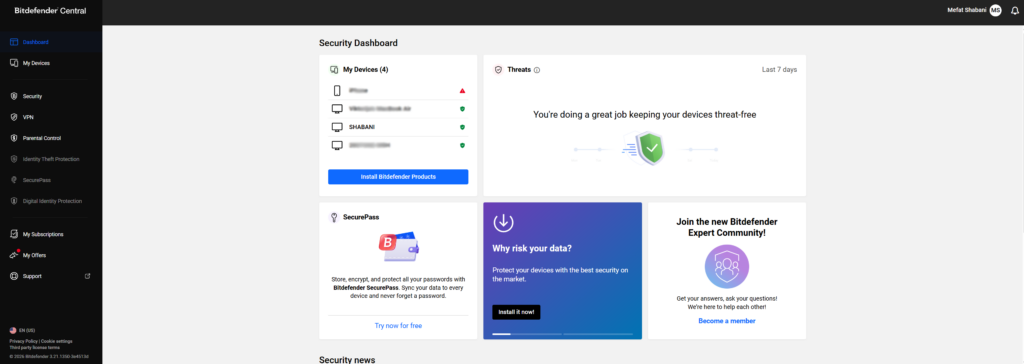
On resource usage, I do not rely only on my own numbers, since one machine is not a representative sample. AV-TEST’s performance data backs this up with a much larger dataset. In most of the tested categories, from loading popular websites to copying files, Bitdefender’s slowdown came in at or below the industry average. Installing frequently-used applications showed the largest measured impact of any category, at 15% on a standard PC, though that still beat the 30% industry average for the same task. Only on launching already-installed software did Bitdefender sit roughly level with the average rather than clearly ahead of it.
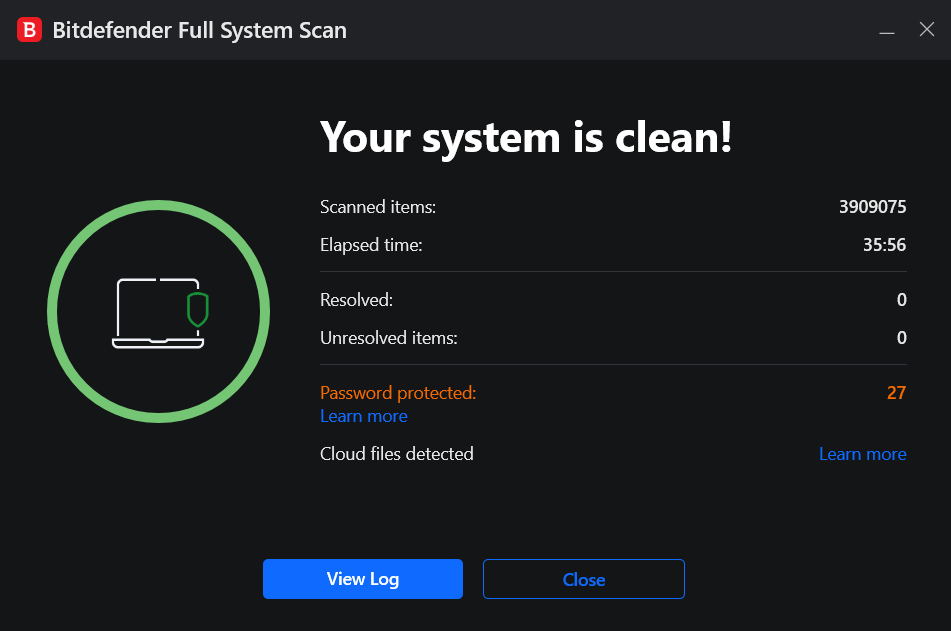
My own numbers from this test run: a full system scan checked 3,909,075 items in 35 minutes and 56 seconds and came back clean, nothing resolved, nothing left unresolved. System CPU sat at 26% and total memory at 26.8 GB of 61.5 GB (44%) on the reading I took.
I also ran the standard, harmless industry tests instead of live malware. The EICAR test file is built specifically so antivirus engines can be verified without using real malicious code, and Bitdefender caught it immediately, flagged as EICAR-Test-File (not a virus) and moved straight to quarantine before I had to do anything.
How Much Does Bitdefender Actually Cost in 2026?
This is the section where I want exact numbers, not words like “affordable.”
Swipe to compare plans →
| Plan | Devices | First-Year Price | What It Adds Over the Base Engine |
|---|---|---|---|
| Antivirus Plus | 3 | $29.99 | Core malware, ransomware, and web protection. Windows only. |
| Total SecurityMost Picked | 5 | $59.99 | Adds macOS, Android, iOS, a password manager, 200 MB/day VPN, vulnerability assessment. |
| Premium Security | 5 | $79.99 | Adds unlimited VPN traffic, Scam Protection Pro, anti-tracker, email protection for 2 addresses. |
| Ultimate Security | 5 | $89.99 | Adds dark web monitoring, an identity protection score, real-time breach notification. |
| Ultimate Security Plus (Extended) | 5 | $139.99 | Adds up to $1M identity theft insurance, 3-bureau credit monitoring, up to $25K ransomware and social engineering resolution. |
Total Security is the plan I'd point most people toward. The identity-monitoring features in the higher tiers are built around U.S. credit and data-broker systems, so they carry less weight if you're buying from outside the U.S.
Sources
Pricing verified directly against Bitdefender's official pricing page, September 2026.
Total Security is also sold as a 25-device Family plan at $79.99 for the first year.
Now the part that bothers me, is that nowhere on that pricing page, or on the Total Security product page, does Bitdefender show the renewal price before you buy. The terms of use state that your subscription will be billed “at the applicable renewal price which may be higher than the initial purchase price,” without saying what that price is anywhere on the purchase flow. You find the real figure only after checkout, inside Bitdefender Central under My Subscriptions and My Payments, or by waiting for the renewal notice email Bitdefender sends 30 days out.
Important for anyone buying today please check that renewal figure the same day you subscribe, not the day it renews. Automatic renewal is switched on by default at checkout, so the number you find in Central matters more than the first-year discount that got you there.
Which Bitdefender Plan Should You Actually Buy?
Antivirus Plus makes sense only if you run a single Windows PC and want core protection at the lowest price. You lose the password manager and any cross-platform coverage.
Total Security is the plan I would point most people toward. It covers Windows, macOS, Android, and iOS across five devices, and bundles a password manager plus a small VPN allowance, enough for the odd public WiFi check-in, not daily browsing.
Premium Security only earns its higher price if unlimited VPN traffic genuinely replaces a subscription you would otherwise pay for separately. If you already use NordVPN or Mullvad, this upgrade duplicates something you own.
Ultimate Security and Ultimate Security Plus add identity monitoring and insurance features built around the US market specifically. European buyers should check what actually applies outside the US, since dark web monitoring and credit bureau monitoring are structured around US data broker and credit systems, before paying the premium for those tiers.
What Do Real Bitdefender Users Say?
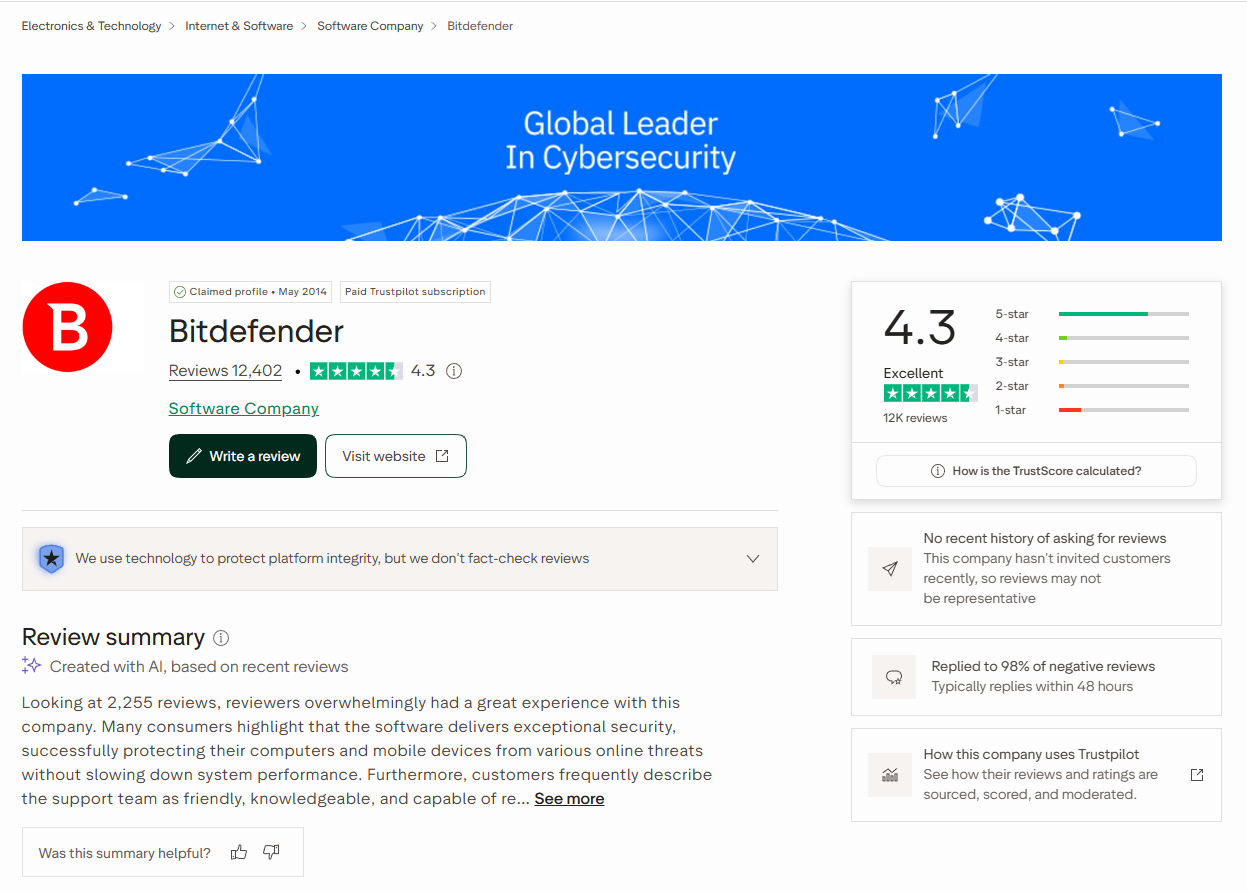
Bitdefender’s Trustpilot page currently shows a 4-star, “Great” TrustScore from roughly 12,260 reviews, as of this writing. The positive reviews repeat a small set of themes: protection that works quietly in the background, mobile scanning that runs on every new app install, and support staff who resolve technical issues over chat without a long wait.
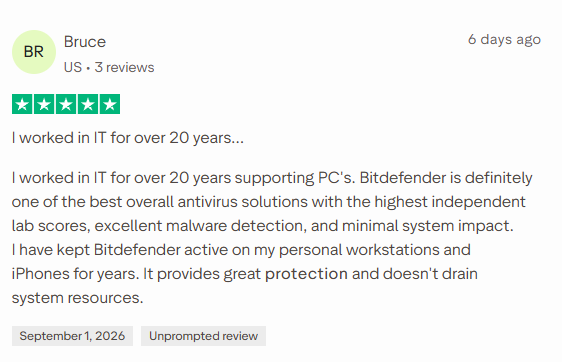
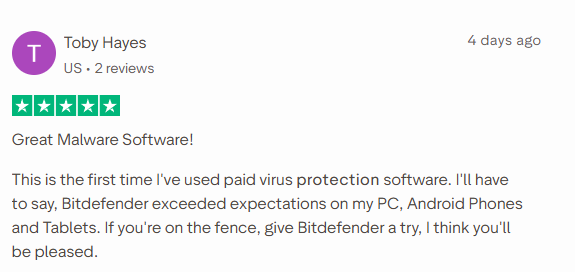
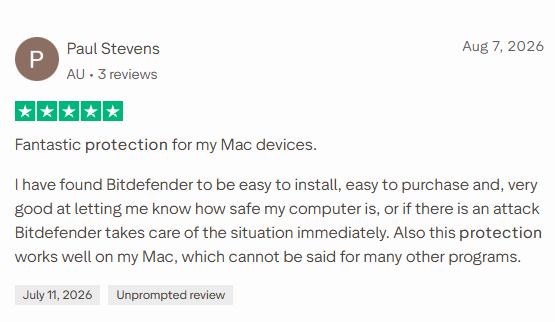
The negative reviews cluster around subscription and billing behavior rather than the antivirus engine itself, a pattern flagged by multiple independent reviewers looking at the same Trustpilot data.
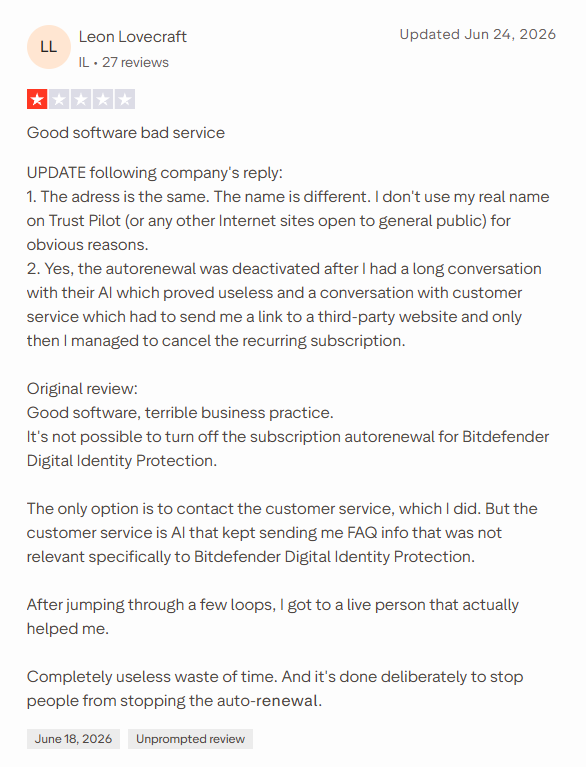
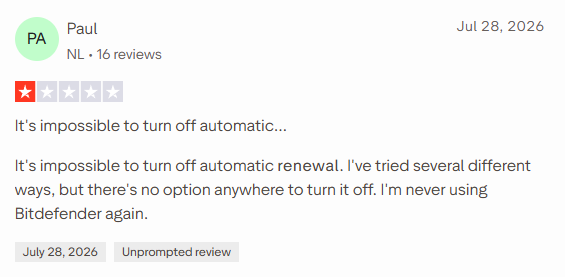
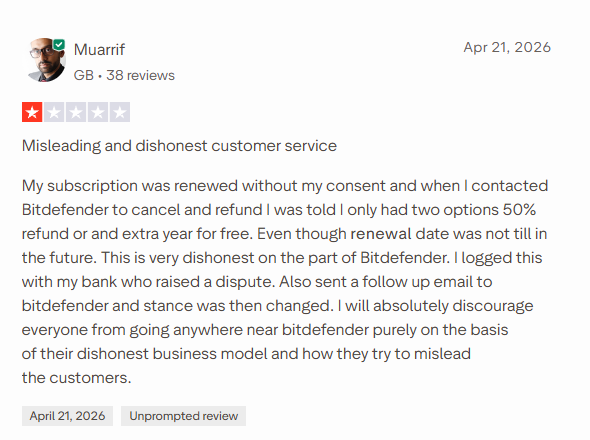
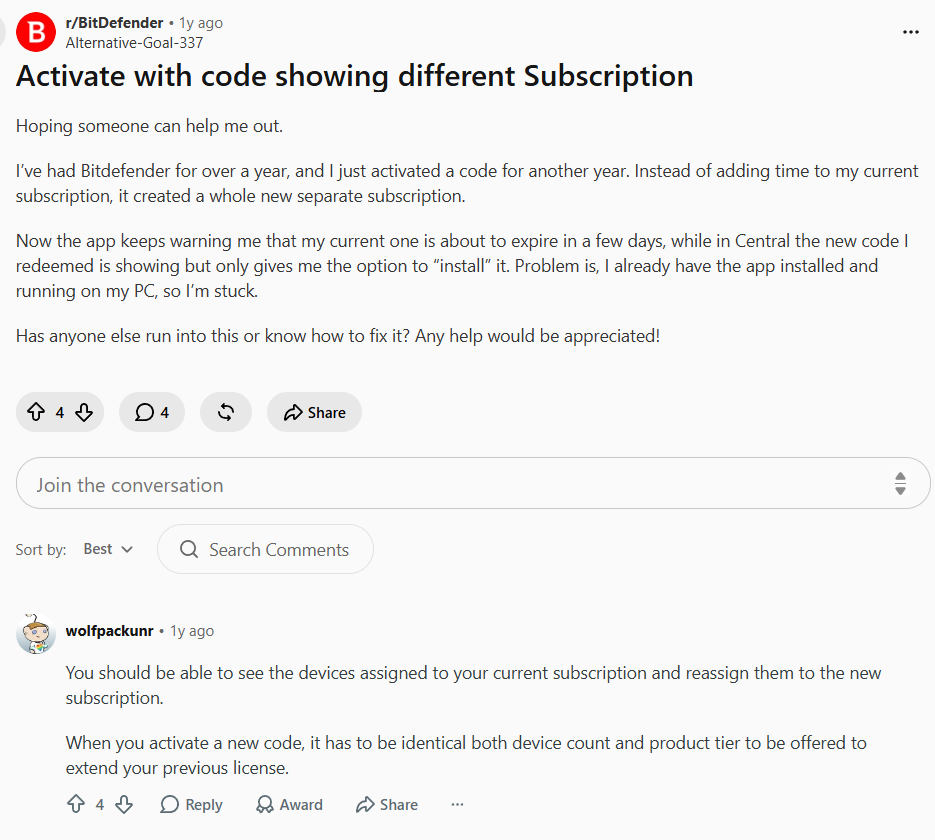
One theme worth flagging is that sometimes a Bitdefender Central renewal purchase creates a separate, second subscription instead of extending an existing one bought through a reseller, briefly overlapping and then losing several days of paid coverage. Where this has surfaced publicly, Bitdefender support resolved it by crediting the lost days. That is a reasonable fix after the fact, but worth knowing before renewing through Central if your original purchase came from somewhere else.
Who Owns Bitdefender, and Does It Matter for Your Data?
Bitdefender is privately held, founded in 2001 in Bucharest, Romania, by Florin Talpeș, who remains CEO and, with his family, the majority shareholder. In 2017, the London-based private equity firm Vitruvian Partners acquired roughly 30% of the company, in a deal that valued Bitdefender at over $600 million at the time. The company is dual-headquartered in Bucharest and San Antonio, Texas, and as a Romanian company it operates under EU law, including GDPR.
On breach history, Bitdefender has two disclosed incidents worth knowing about. In 2015, attackers accessed a server holding usernames and encrypted passwords for around 250 accounts. In 2020, researchers found a remote code execution vulnerability in the free Windows version. According to Security.org’s research, Bitdefender disclosed both issues and shipped fixes within 48 hours, and there is no public evidence the 2020 flaw was exploited before the patch. Neither incident is recent, and the response time in both cases was fast by industry standards, but a product asking for this much system access is a reasonable place to want a clean record, and this one is not spotless.
Bitdefender’s own telemetry and threat-intelligence pipeline is also broader than a bare-bones antivirus needs to be, especially once you add the identity-monitoring features in the higher tiers. If minimizing what a vendor collects matters more to you than those extra features, weigh that against the lab scores above before choosing a tier.
Bitdefender vs Windows Defender: Do You Actually Need to Pay?
This is the question every Windows user should ask before buying any third-party antivirus. Windows 11 ships with Microsoft Defender for free, and Defender has genuinely closed the gap on raw detection.
Across several 2026 AV-TEST rounds, Bitdefender and Microsoft Defender have scored identically at 18/18. In the June 2026 round, Bitdefender held its perfect score while Defender slipped to 17.5/18 on a performance dip. Neither result is a decisive win for either product on protection alone.
Where Bitdefender earns its price is everything Defender does not do: cross-platform coverage for Mac, Android, and iOS in one subscription, a bundled password manager, vulnerability assessment for outdated software and missing patches, ransomware-specific folder protection, and a VPN, however limited, without a separate app. If you already run Microsoft Defender alongside a dedicated password manager, a VPN you trust, and good update habits, you are not obviously under-protected. Bitdefender’s case is convenience and breadth in one product, not a large jump in raw detection.
What Works Well
- Independent lab results are consistent, not a one-time score. Bitdefender’s June 2026 AV-TEST result of 18/18 sits alongside an Advanced+ rating from AV-Comparatives in the same window, from two labs running completely different methodologies. That kind of agreement across independent testers is harder to fake than a single good month.
- Performance impact stays close to or below the field average in most tested categories. AV-TEST’s May-June 2026 breakdown shows Bitdefender ahead of the industry average in website loading and file copying, and clearly ahead on application installation, where it measured 15% against a 30% average.
- The Total Security tier bundles real utility, not filler. A password manager, vulnerability assessment, and ransomware-specific folder protection are each useful on their own, and having them under one subscription and one interface removes friction that adds up when you manage three or four separate tools instead.
- User sentiment on the actual protection is genuinely positive. Across roughly 12,260 Trustpilot reviews, the recurring praise is specific: quiet background protection, fast mobile scanning, and support staff who resolve issues without long delays, not vague five-star ratings with nothing behind them.
What Needs Work
- The renewal price is not shown before you buy. Bitdefender’s own terms confirm the first-year figure is promotional and that renewal happens at a higher, unstated rate. You only find the real number in Bitdefender Central after your payment method is already on file.
- The bundled VPN is too thin to replace a real one. 200 MB per day, about 6 GB a month, covers checking email on public WiFi once in a while. It does not cover streaming, daily browsing, or anything you would route through a VPN out of habit. Anyone who wants a VPN as an actual feature, not a checkbox, needs Premium Security or a separate subscription,
- Subscription and billing complaints are a recurring theme in user feedback, based on the pattern flagged repeatedly across independent coverage of Bitdefender’s Trustpilot reviews.
- The privacy and breach disclosure record is not spotless. A 2015 server breach and a 2020 RCE vulnerability in the free product are both old and both resolved quickly, but Bitdefender’s identity-monitoring features also mean the company handles more of your personal data than a bare malware scanner would. That trade-off deserves a conscious decision, not an assumption.
Who Should Buy Bitdefender, and Who Should Not?
Buy Total Security if you want one subscription covering Windows, Mac, and mobile, do not already own a password manager, and want vulnerability scanning without a separate tool. It is the plan I would point most non-technical readers toward.
Skip Bitdefender, or stick with Antivirus Plus, if you already run Defender, a dedicated password manager, and a VPN you trust on a single Windows machine. You are not meaningfully under-protected, and the higher tiers would mostly pay for overlap.
Move up to Premium Security only if unlimited VPN traffic genuinely replaces a subscription you would otherwise pay for. Check what you already spend on a VPN before assuming this tier saves money.
Think twice about Ultimate Security and Ultimate Security Plus if you live outside the US. The identity-theft insurance and credit monitoring in those tiers are built around US financial and credit infrastructure, and their value drops for European buyers.
Is Bitdefender Worth Buying in 2026?
Yes, for the antivirus engine specifically. Two independent labs, using different test methods and different malware sets, both put Bitdefender in the top tier for the same window in 2026: 18/18 from AV-TEST and Advanced+ from AV-Comparatives with a 99.5% real-world protection rate. That is not marketing. It is measured by people with no reason to inflate the number.
Bitdefender Review FAQ
Is Bitdefender a good antivirus?
Yes. Bitdefender is one of the strongest consumer antivirus products in current independent testing. AV-TEST awarded Bitdefender Total Security 6/6 for protection, 6/6 for performance, and 6/6 for usability in its May-June 2026 Windows 11 test.
Is Bitdefender better than Windows Defender?
Not necessarily for every user. Microsoft Defender provides strong built-in protection, while Bitdefender adds a broader security suite with features such as ransomware protection, vulnerability assessment, additional web protection, VPN, password management and scam protection.
Does Bitdefender slow down your computer?
Bitdefender uses system resources during scans and real-time protection, but its overall performance impact is generally low. In my own test, Bitdefender scanned 3,909,075 items in 35 minutes and 56 seconds on my Ryzen 9 9950X3D system with 64GB of RAM and NVMe storage.
How long does a Bitdefender full system scan take?
It depends heavily on the hardware, storage, number of files and amount of data being scanned. On my test PC, Bitdefender scanned 3,909,075 items in 35 minutes and 56 seconds. Tom’s Guide reported 26 minutes and 23 seconds while scanning 2,319,256 files on its test system.
Does Bitdefender protect against ransomware?
Yes. Bitdefender uses multiple ransomware protection layers, including Advanced Threat Defense and Safe Files. These technologies are designed to identify suspicious behavior and prevent unauthorized applications from modifying protected files.
Does Bitdefender detect phishing websites?
Yes. Bitdefender’s Online Threat Prevention module is built to block known-malicious websites, phishing pages, and unsafe downloads automatically as you browse, protecting against fraudulent pages that try to steal credentials or personal information.
Does Bitdefender have a VPN?
Yes. Total Security includes 200 MB of VPN traffic per device per day, enough for occasional use, while Premium Security and above include unlimited VPN traffic. I would consider the VPN a useful extra rather than the main reason to choose Bitdefender.
Which Bitdefender plan should I buy?
For most users, I would choose Bitdefender Total Security. It provides the core antivirus, ransomware, web and vulnerability protection without requiring you to pay for every premium feature. Premium Security makes more sense if you specifically need unlimited VPN traffic, while Ultimate Security is aimed at users who want additional identity protection.
Is Bitdefender worth paying for?
Yes, if you want a dedicated commercial security suite. Bitdefender’s strongest argument is its combination of excellent independent protection results, multi-layer detection, ransomware protection and relatively low performance impact. However, check the renewal price before purchasing because promotional pricing may not continue.
Does Bitdefender automatically renew?
Bitdefender subscriptions can automatically renew when automatic renewal is enabled. I recommend checking the renewal setting and price in Bitdefender Central before the subscription expires, especially if you purchased using an introductory promotion.
Is Bitdefender safe to use?
Yes. Bitdefender is a legitimate cybersecurity company whose products are regularly evaluated by independent antivirus testing organizations. Its consumer products use multiple protection layers, including real-time scanning, behavioral detection, web protection and cloud-based threat intelligence.
Cheers,
Mefat